
Mold Inspection and Testing in Lowell
Mold inspection and testing in Lowell, MA. Insurance billing accepted. Call (978) 482-6260.
Our technicians are dispatched from our Burlington, MA headquarters and are typically on-site in Lowell within 60 minutes of your call.
Mold inspection and testing calls in Lowell tend to cluster around a particular kind of building: the brick mill structure converted to residential lofts, and the wood-frame triple-decker that makes up so much of the city’s older housing stock. Both sit close to the Merrimack River and the historic canal system that once powered the mills, and both hold moisture differently than a typical suburban build. A mold inspection here has to account for that before it accounts for anything else.
Why Lowell Properties See Mold Issues
Lowell’s canal network and river proximity keep ambient humidity higher in low-lying parts of the city, and that humidity finds its way into basements and ground-floor units long before anyone notices a visible stain. Triple-deckers built in the late 1800s and early 1900s often share foundation walls and have shallow, poorly ventilated cellars where plumbing runs for three separate units converge. A slow leak behind one wall can read as a musty smell two floors away before it ever shows as a spot on drywall. The converted mill buildings present a different problem: thick brick exterior walls and heavy timber framing that were never designed with vapor barriers, paired with modern HVAC and plumbing retrofits that can trap condensation inside the wall cavity. Mold colonization in a hidden cavity like that can start within 24 to 48 hours of sustained moisture, well before a tenant or owner has any visual cue.
Our Mold Inspection and Testing Process in Lowell
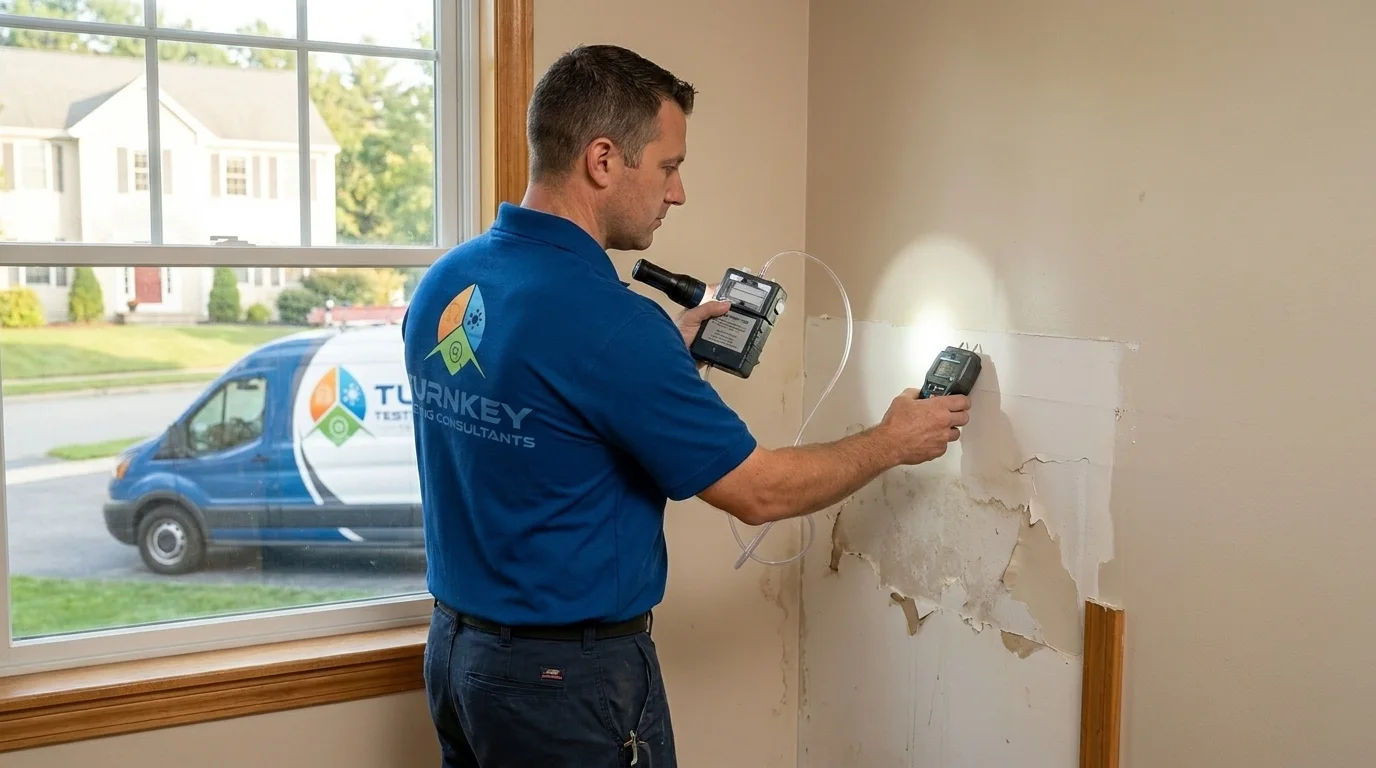
We start with a visual and moisture-meter walkthrough, checking the areas most likely to hold hidden dampness given the building type, basement sill plates and shared walls in triple-deckers, and exterior brick junctions and old mechanical chases in converted mill units. From there we collect air samples and, where visible growth is present, surface swabs or tape lifts. Samples go to an independent lab for spore analysis so the results are not something we are grading ourselves. Once results come back, we walk the owner or property manager through what the spore counts and species actually mean for that specific property, not a generic mold pamphlet, and outline next steps if remediation is warranted. We do not perform the lab analysis in-house, which keeps the inspection findings independent of any remediation recommendation that follows.
Equipment & Methods We Use for Mold Inspection
For Lowell’s older buildings we lean on thermal imaging alongside standard moisture meters, since thermal cameras pick up the temperature differential behind brick and plaster that a pin-type meter alone can miss. Air sampling uses spore trap cassettes calibrated for both indoor and outdoor comparison, which matters in a river city where outdoor ambient spore counts can run higher during warm, humid stretches. In units with visible growth, we also use swab or bulk sampling depending on the surface, since painted drywall and exposed timber beams don’t hold samples the same way.
Reaching Lowell from Burlington
Our base in Burlington puts Lowell within a straightforward run up Route 3 or over to I-495, and we schedule inspections across the city without treating any part of it as out of the way. Whether the property is a triple-decker near the canal district or a converted mill loft closer to downtown, the drive time from our office is short enough that scheduling is rarely the bottleneck, the testing and lab turnaround generally is.
Local note
One thing that trips up a lot of first-time inspections in Lowell’s mill-building conversions: the original brick exterior walls act like a thermal mass, staying cool and slightly damp on the interior face even when the unit’s HVAC is working fine. That cool brick surface condenses moisture out of the air inside the wall cavity, especially behind furniture or built-ins pushed up against an exterior wall. We factor that into where we place moisture meters and air sampling points rather than relying on a single reading near the HVAC vent, which is where a less thorough inspection tends to stop looking.
If something in a Lowell triple-decker, mill loft, or single-family home smells off, looks discolored, or just has you wondering what’s behind the drywall, a proper mold inspection and air quality test gives you lab-backed answers instead of guesswork. Call (978) 482-6260 to get a mold inspection and testing visit scheduled for your Lowell property.
Mold Inspection and Testing in Lowell: Service Coverage
Frequently Asked Questions
How fast can you arrive for mold inspection and testing in Lowell?
Are Lowell's triple-decker homes more prone to hidden mold growth than newer construction?
Do converted mill buildings in Lowell need a different mold inspection approach than a standard home?
How long does mold spore testing take once samples are collected from a Lowell property?
Does Lowell's proximity to the Merrimack River affect indoor air quality testing results?
What does a mold inspection cost for a Lowell triple-decker versus a single mill-loft unit?
Will my homeowners insurance cover mold inspection and testing in Lowell?
Mold Inspection and Testing response in Lowell
Most Lowell calls see a technician on-site within 60 minutes from our Burlington headquarters.